


Age-related macular degeneration is one of the leading causes of vision loss in older adults, yet many people don’t notice symptoms until central vision has already changed. At Eyecare Associates of Lewistown, we help Fergus County patients monitor macular health closely, catch changes early, and understand their treatment options as they arise. Early detection makes a real difference in preserving your sight.

Macular degeneration is a progressive condition affecting the macula, the part of the retina responsible for sharp, central vision. It typically appears in one of two forms. Dry macular degeneration develops as metabolic waste builds up in the macula, forming deposits called drusen. Wet macular degeneration occurs when fragile new blood vessels grow beneath the retina and leak fluid or blood. Both forms can affect your central vision over time, though they progress differently.
Early macular degeneration often causes little to no noticeable change, which is why regular exams matter even when your vision feels normal. As the condition progresses, straight lines may appear wavy or distorted, and you may notice blurred vision or gray and black spots in your central field of view. Wet macular degeneration can cause these changes suddenly, so any rapid shift in your central vision needs prompt attention.
A comprehensive dilated eye exam allows our doctors to examine your macula directly and look for early signs of drusen or other changes. We also use optical coherence tomography, or OCT, which captures detailed cross-sectional images of the retina. This technology lets us see beneath the surface and track even small changes over time, so we can catch progression early and adjust your care plan accordingly.


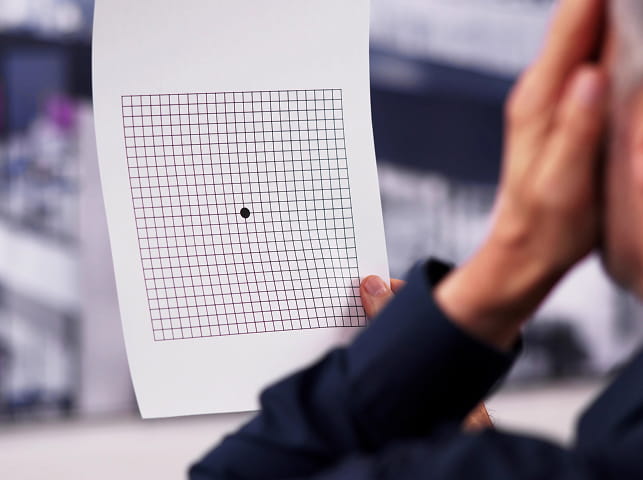
Most cases of macular degeneration are the dry form, and while there’s no cure, several steps can help slow its progression. We often recommend quitting smoking, protecting your eyes from UV exposure, eating more green leafy vegetables, and taking AREDS2 vitamin supplements if appropriate for your stage. Between visits, monitoring your vision at home with an Amsler grid can help you notice changes early.
When dry macular degeneration progresses to the wet form, timely treatment becomes especially important. If we detect signs of wet AMD, such as sudden distortion or new blind spots, we refer you promptly to a retina specialist for intravitreal injections, a treatment that can slow or stop abnormal blood vessel growth. Our team stays involved throughout, coordinating your care and monitoring your vision alongside your specialist.
Dry macular degeneration involves a gradual buildup of drusen deposits in the macula, while wet macular degeneration occurs when abnormal blood vessels leak fluid or blood beneath the retina. Wet AMD tends to progress more quickly and needs prompt treatment.
An Amsler grid is a simple pattern of straight lines used to check for changes in your central vision at home. If the lines start to look wavy, distorted, or missing in places, it can be an early sign of macular degeneration progression.
There’s currently no cure for macular degeneration, but treatment and lifestyle changes can slow its progression and help preserve your remaining vision, especially when caught early.
Not always. AREDS2 supplements are typically recommended for patients with intermediate or advanced dry macular degeneration. Your optometrist can tell you whether they’re appropriate for your specific stage.
Most adults over 60 benefit from an annual dilated eye exam, though your optometrist may recommend more frequent visits if you have risk factors or early signs of the condition.